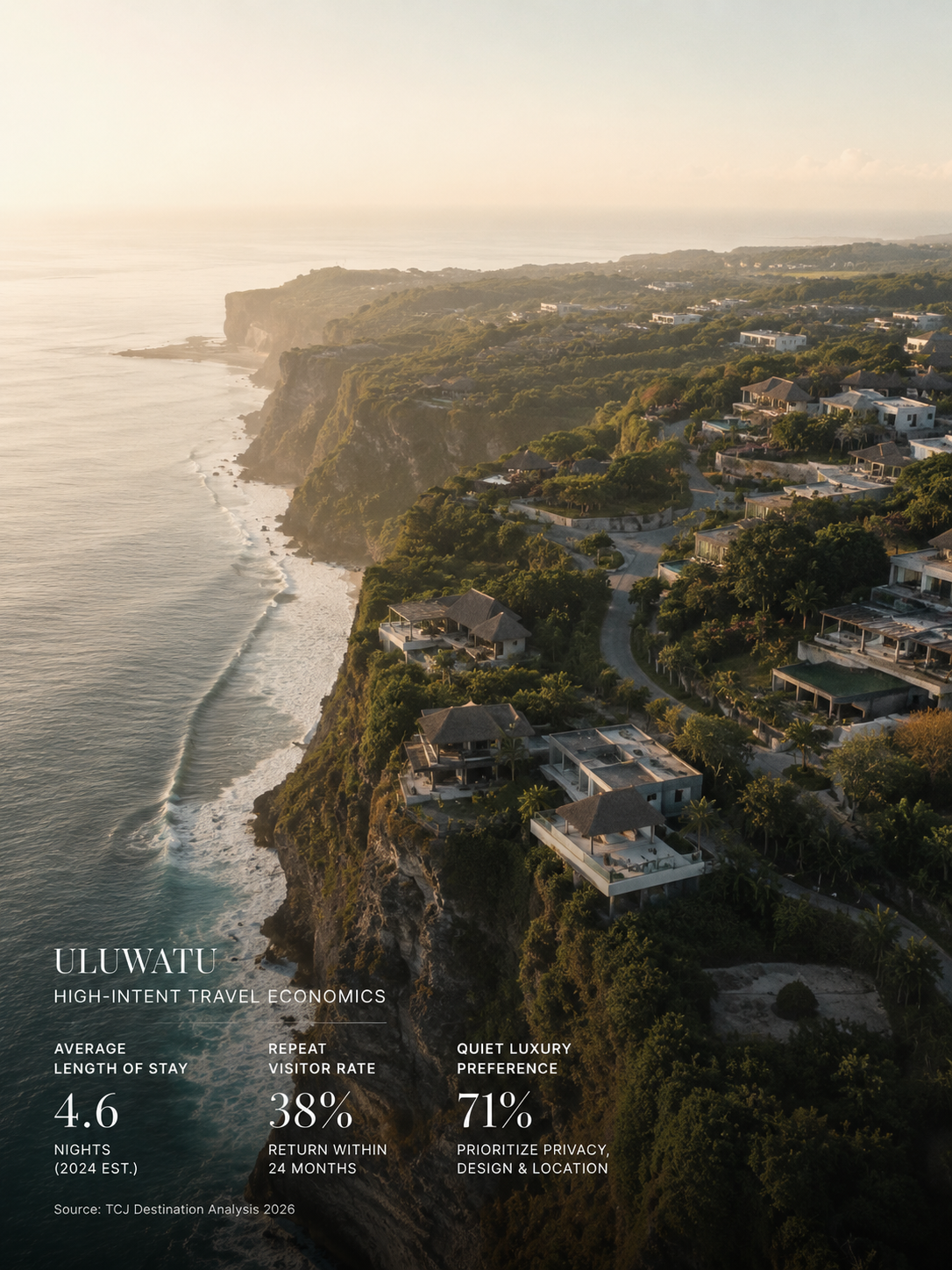
Why Uluwatu Keeps High-Intent Travelers
The economics of a destination that rewards longer stays and slower decisions.
Intent Is Not the Same as Spend
In travel, high intent is often confused with high spend. The two may overlap, but they are not identical. A high-spend traveler can move quickly, consume visibly, and leave little behind beyond a transaction. A high-intent traveler chooses with more friction. They research longer, return more deliberately, and often care less about having the most obvious address than the right one.
Uluwatu is built for this second category. Its geography resists total convenience. The roads ask for patience. The cliffside locations reward commitment. The best experiences are rarely stumbled into at speed. They require a traveler to decide that slowness is part of the value.
The Geography of Slower Decisions
Unlike destinations organized around a central boulevard or a single hotel corridor, Uluwatu is dispersed. Desire is spread across ridges, roads, beaches, compounds, and cliff edges. This dispersion changes the economics. It makes discovery feel earned. It allows smaller properties, dining rooms, studios, and service providers to exist within a larger field of attention.
The traveler who comes here with intention is not simply buying a room or a meal. They are buying the right to move through a geography that still feels partially unstandardized. That feeling is commercially powerful, but also delicate.
Uluwatu rewards the traveler who accepts that convenience is not always the highest form of luxury.
Scarcity, Stay Length, and Return Desire
Scarcity in Uluwatu is not only about limited supply. It is about limited states of mind. The right hour, the right road, the right table, the right room facing the right kind of silence, these are not infinitely reproducible. They give the destination a rhythm that encourages longer stays and repeat consideration.
A traveler may come first for the view and return for the pacing. That shift matters. Views attract attention. Pacing builds loyalty. The destination’s strongest economic asset may therefore be its ability to make travelers feel that one visit is insufficient, not because they missed something, but because they only began to understand the sequence.
What the Cliff Economy Rewards
The cliff economy rewards selectivity. It favors operators who understand that not every demand should be answered, not every surface should be monetized, and not every hour should be programmed. This can be difficult in a market under growth pressure. The short-term incentive is to add: more rooms, more tables, more visibility, more proof.
But Uluwatu’s high-intent traveler often responds to the opposite. They reward edited choices, controlled access, and the feeling that the destination has not fully surrendered to optimization.
Uluwatu keeps high-intent travelers because it asks something of them. It asks them to choose, wait, move slowly, and accept that the best parts of a place may not be immediately convenient. In that friction lies the destination’s commercial intelligence.
“High intent is measured less by what travelers spend than by how carefully they choose.”