The Carnegie Journal: From Print Heritage to a UK-Based English-Language Journal
A physical edition that existed before the domain — opening a digital address in May 2026 and extending a carefully curated editorial world internationally
The history of The Carnegie Journal did not begin with a website.
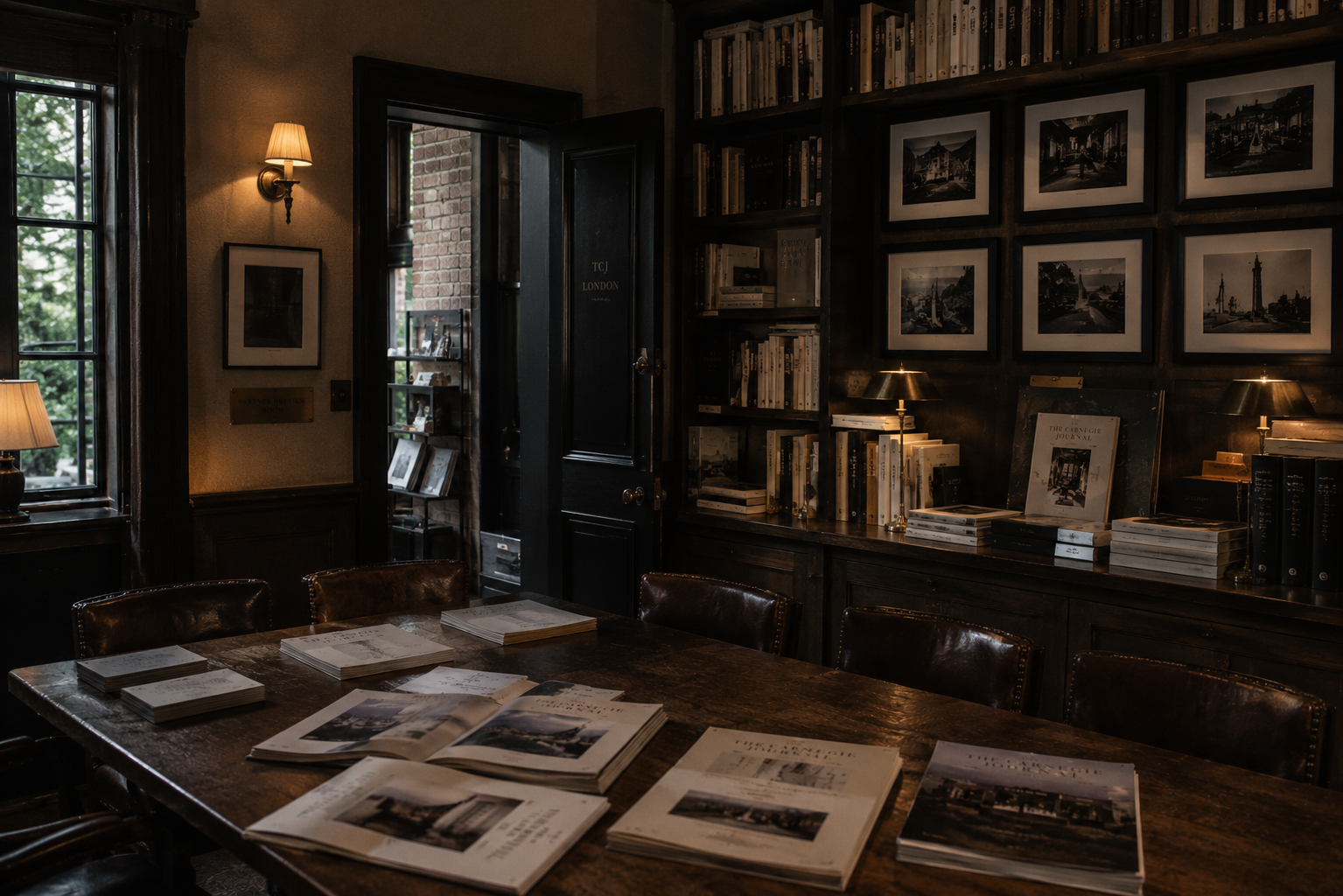
Before its current domain was registered, The Carnegie Journal already existed as a physical print edition. A complete journal — with its own cover, pages, photography and writing — came first. The digital publication followed later.
Today, many publications begin on screen and eventually expand into print. The Carnegie Journal took the opposite path.
Its name appeared on a cover before it appeared on a webpage, and its editorial language took shape within printed pages before it was expressed through online articles. Through the order of its pages, the use of space, the scale of its images and the rhythm of its writing, The Carnegie Journal established a visual order of its own.
The website did not create the journal.
It gave an already existing print journal a public address.
A Journal That Existed Before the Domain
The first page of The Carnegie Journal was opened not in a browser, but on paper.
The physical edition was not a promotional object created merely to introduce a future digital publication. It was an independent print journal in its own right, complete with a cover, page architecture, editorial structure and visual language.
From the beginning, the journal did not seek to include as many subjects as possible.
Rather than asking which places were famous, it considered why they deserved to be remembered. Rather than following whichever brands happened to be in fashion, it looked for those capable of leaving behind a distinctive attitude and atmosphere long after the moment had passed.
To select carefully rather than publish extensively.
To create lasting scenes rather than rapidly consumed information.
The editorial standards of The Carnegie Journal were shaped on the printed page around these principles of selection.
«The Carnegie Journal was already a journal before it became a website. It had a cover before it had an address, and pages before it was made public.»
An Exclusive Heritage Shaped by Limited Circulation
As a physical edition, The Carnegie Journal was characterised less by mass distribution than by selective circulation.
It did not assemble places and brands indiscriminately, but focused on subjects capable of carrying meaning within the journal’s pages. The number of features mattered less than the context in which each subject appeared.
That approach became the origin of what The Carnegie Journal now describes as exclusivity.
Exclusivity does not simply mean restricting access to a select few. It means exercising care over what enters the journal and giving each chosen subject sufficient space, language, imagery and visual breathing room.
The Carnegie Journal aspires to be a collection rather than a catalogue.
Rather than displaying many things quickly, it edits selected places and brands so that they remain as a lasting impression. Each subject is given its own context, shaped around its atmosphere and story, rather than being reduced to a uniform format.
Because not everything can enter, what is selected carries greater meaning.
May 2026: A Public Address for the Print Journal
In May 2026, The Carnegie Journal registered its current domain and opened its digital publication.
This was not the date on which The Carnegie Journal first came into existence. It was the point at which a journal that had already existed in print was given an official digital address.
The covers, writing, imagery and editorial order that had lived on paper began to expand into digital issues, city guides and editorial features.
«The Carnegie Journal was not born in May 2026. The doors of an already existing journal were opened to the digital world.»
The domain was not a point of origin, but a point of transition.
The website did not replace the physical journal. It became a new editorial surface through which the language first developed in print could connect with a wider readership, new cities, and a broader range of places and brands.
The sensibility formed in print moved onto the screen, while the space and order of the physical page were reinterpreted for a digital environment.
The format changed. The principle of selection did not.
The Next Chapter as a UK-Based English-Language Journal
The print heritage of The Carnegie Journal now continues through a UK-based English-language editorial structure.
Based around the UK company Metilience Global Ltd, The Carnegie Journal records cities, places, hospitality and lifestyle brands within an international English-language context.
The United Kingdom represents more than a registered address.
It provides a foundation for connecting traditions of print culture, independent publishing, restrained editorial design and English-language journalism with a contemporary digital format. Within this framework, The Carnegie Journal presents places and brands from Korea and across Asia through an international editorial language that reaches beyond local description.
Seoul is currently the principal city in which The Carnegie Journal’s city guides and partnership formats are being introduced. Yet its visual language and English-language editorial structure were never designed to remain within a single city.
To record places discovered in Seoul in English and connect them to a wider international context through a UK-based publishing framework.
To bring together the atmosphere and addresses of London, Seoul and other cities within a single journal.
This is how The Carnegie Journal carries its print heritage forward.
A Journal for Selected Places and Brands
Even after opening its digital publication, The Carnegie Journal did not choose to become a publication that covers everything.
Digital media made it possible to publish more subjects at greater speed, but The Carnegie Journal continues to place selection above volume.
It does not record something simply because it is famous. It does not feature something simply because it is new. It does not give up its pages simply because a place attracts a large audience.
The journal considers the atmosphere and history of a place, the visual world a brand has built, and the meaning a subject holds within its city. It then selects those capable of remaining within the editorial context of The Carnegie Journal.
What the journal provides is not merely exposure.
It creates an editorial context in which selected places and brands can be read more deeply, presented more precisely and remembered for longer.
The standards that began with the physical edition continue across its digital issues, city guides, English-language brand features and partnership formats.
A Heritage That Began in Print
The heritage of The Carnegie Journal does not lie in presenting a lengthy chronology.
It lies in the physical edition that existed before the domain, the visual language formed on paper, the selective circulation and carefully chosen records, and the continuation of that tradition through a UK-based English-language digital journal.
The domain registered in May 2026 was not the first page of that history.
It was the next chapter opened by a journal that had already existed in print, allowing it to meet new readers and new cities.
A physical journal that existed before the domain.
A print heritage shaped by selective circulation rather than mass exposure.
An editorial world that opened its digital address in May 2026 and expanded as a UK-based English-language journal.
The Carnegie Journal does not seek to become the publication that features the greatest number of things.
It seeks to be a journal in which what is selected carries meaning, and what is recorded is made to last.
Because not everything can enter, what is selected endures.